
Shipper
Everyone answers your project in the same structure.
The problem
Three carriers quote your project three different ways. One all-in, one without chassis, one with a fuel surcharge you cannot check. Choosing between them is guesswork dressed as procurement, and the cheapest number is usually the one that left the most out.
What changes
- 1
Everyone answers your project in the same structure
Line haul, fuel, chassis, accessorials. The same fields from every carrier, so the comparison is a comparison rather than a translation exercise.
- 2
The surcharge is checkable
It follows a published index with a stated threshold and step. You can recompute it yourself, which means you can also tell when it stops matching.
- 3
You see who you would be working with before you dial
Terminals they work, endorsements they hold, where they deliver, what they will not carry — and how long ago they confirmed any of it.
- 4
Rate history that outlives the quote
A published rate is a version, not an edit. What applied last March still says so.
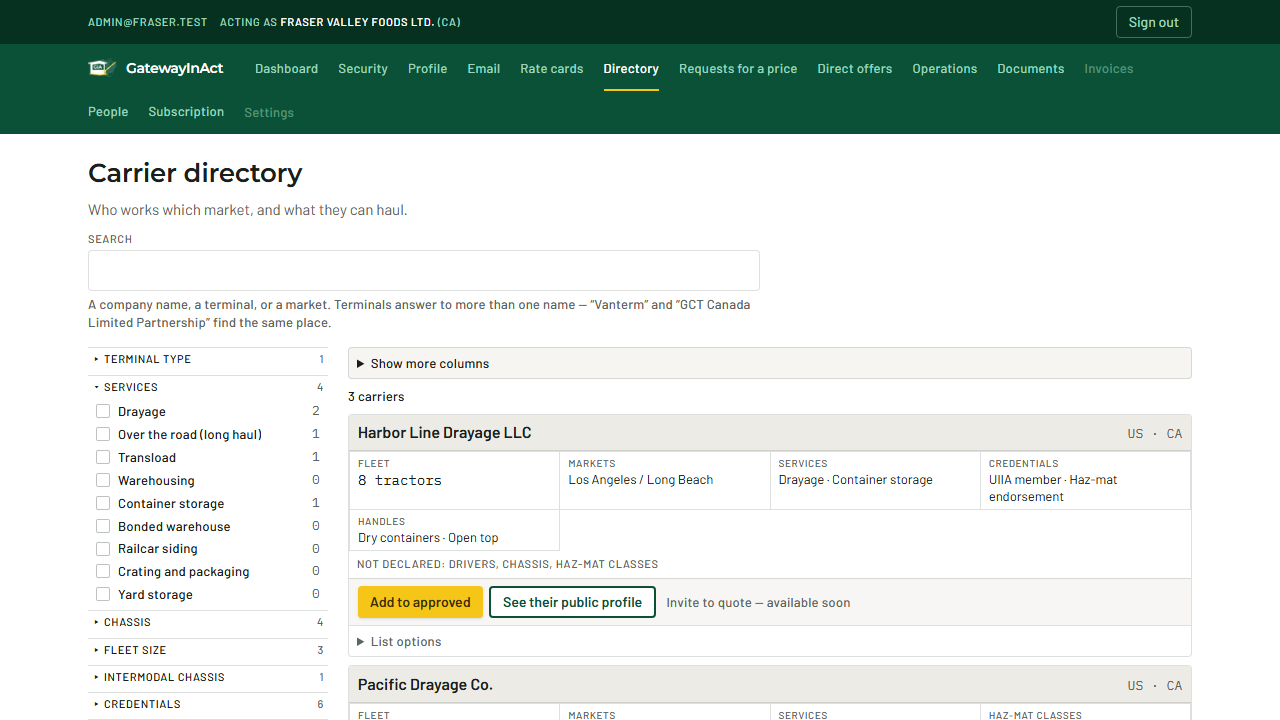
The directory, with the columns a buyer chose to compare on.
- 766
- terminals
- 49
- accessorial charges
- 3
- fuel indices
$40 for the first, $30 each from two to ten
Banded, and the table is published: $40 for the first seat, $30 each from two to ten, and above ten we talk. The same price in every country we operate in. The API is included, because integrating your systems is what makes this worth staying in. And the price you sign up at does not rise at renewal — no small promise in a trade where the standard tool raises it by 25 to 45 per cent.
How you pay
Monthly by card, or annually by bank transfer — with 10% off the twelve months. The transfer option is not an afterthought: a mid-sized company in Mexico or Colombia invoices annually by transfer far more comfortably than it takes a monthly card charge.
The price you sign does not rise at renewal.